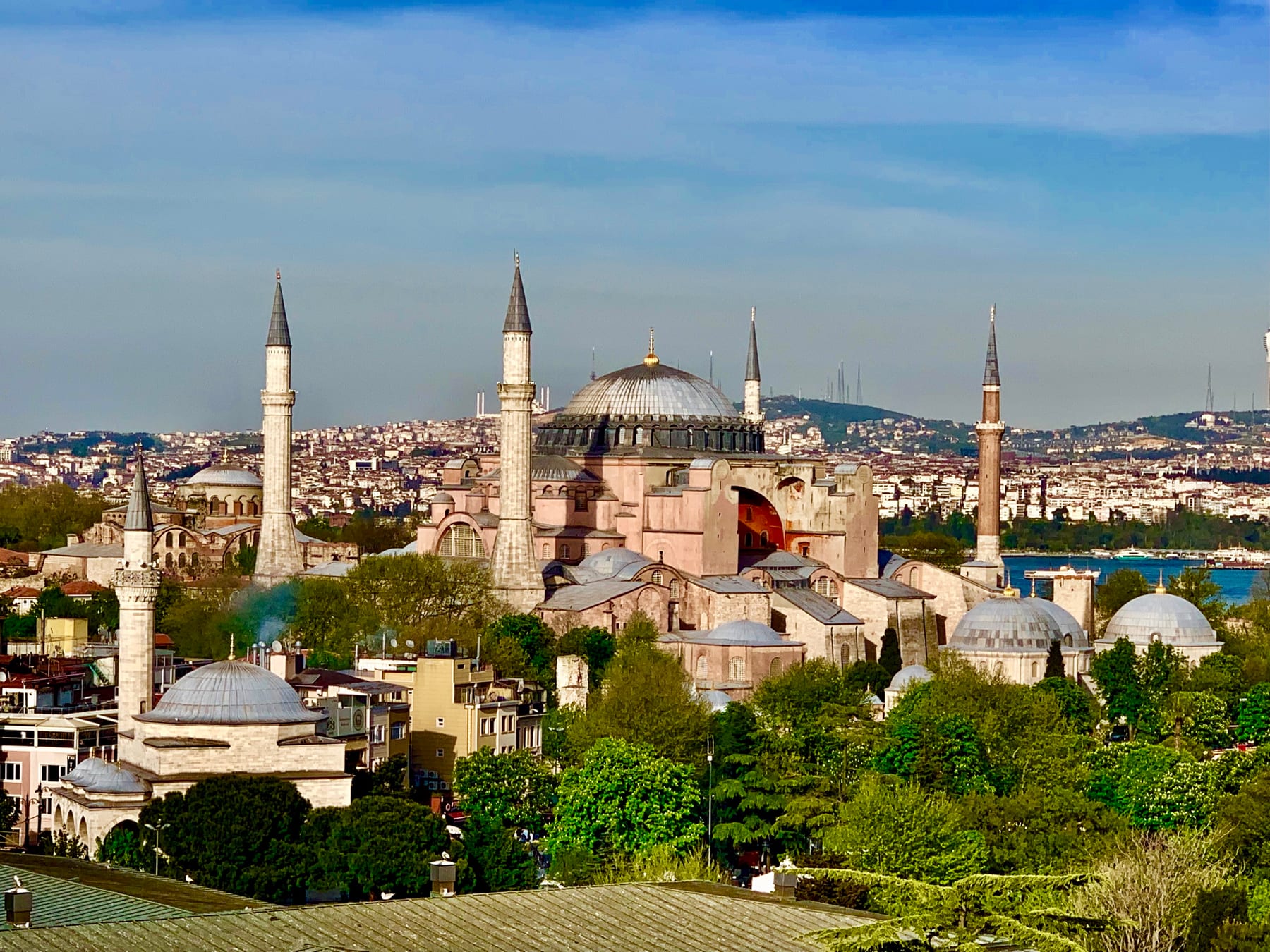
Istanbul keeps its greatest century inside a few streets.
Fifteen hundred years of Byzantine and Ottoman history beneath one of the world’s great domes. Sultan Ahmed’s cascading roofline and the Iznik tiles that gave his mosque its name. An underground reservoir built when Justinian ruled here, its columns still standing in the water. Obelisks in the square where Constantinople settled its arguments. And sixty covered streets of carpets, lanterns, gold and spice at the end of it.
We are a registered, owner-operated boutique travel agency in Istanbul, and most of what we do is private guided tours. Our private Old City tour walks that ground in a single day, for your party and nobody else: Hagia Sophia to begin, then Topkapi Palace or the Basilica Cistern — one or the other, and the choice is entirely yours — followed by the Blue Mosque, the Hippodrome, and the Grand Bazaar last of all. Your own licensed guide throughout, and no strangers on the day.
The guiding and every entrance fee are inside the quoted price, and so is our profit. That last part deserves a moment of your attention, because it is the reason the Grand Bazaar feels different in our company than it does in anyone else’s. Everything we earn from your day is agreed before you arrive, so nobody walking beside you has a reason to steer you anywhere.
What is included in the Old City tour?
A licensed guide, for your party alone, and the entrance fees to the monuments you visit. The day opens at Hagia Sophia. From there it is your choice — Topkapi Palace or the Basilica Cistern — and then the Blue Mosque, and the Hippodrome, the long open square with its ancient obelisks that was the heart of Constantinople and where the day’s history finally ties itself together. The Grand Bazaar comes last. All of it is made on foot, which is not a compromise: the great monuments of Sultanahmet stand within a few streets of one another, and the walking between them is a good deal of the pleasure.
That choice is worth a word, because the two are not variations on a theme. Topkapi is a museum in the traditional sense — the court of the Ottoman sultans, its collections and its Harem, crossed in the open air. The Basilica Cistern is something else entirely: a sixth-century underground reservoir reached by a staircase down into the cool, where hundreds of softly lit columns rise out of the water. If palace collections are not the reason you came, or if there are children or teenagers with you, the Cistern is the one we would suggest. Ask your guide and you will get a straight opinion rather than whichever is easier to arrange.
As a registered Turkish agency we hold your tickets before you land. What we will not call that is skipping a line — Turkey has no priority-entry product, and the security check applies to every visitor who enters. What it does mean is that there is no ticket office to find and no admission to pay at any door. You will be sent the list of exactly what is included alongside your itinerary, before you decide anything. There is more on the arithmetic in our note on what a private Istanbul tour really costs.
Lunch and drinks we leave to you, and that is deliberate. A tour that covers your lunch has already chosen the restaurant, and a restaurant chosen for a group is rarely the one you would have picked — the same arrangement as the back room of a shop, in a nicer chair. So you eat where you like, and your guide will tell you honestly which places nearby are worth your afternoon.
Why does that matter at the Grand Bazaar?
Because of what is not in the price: anything that might still be earned from you later.
The bazaar is the last stop of the day, and across this industry that is rarely an accident. The oldest arrangement in the trade is the one where a guide is paid little and makes the difference in the back room of a shop, and it works best at the end, after hours of good company have made it hard to say no. It is why so many tours arrive under the arch with a destination already chosen, and why the afternoon acquires a faint weight the moment you step inside.
Our guiding fee, the entrance fees and our profit are all agreed before you arrive. There is nothing further to come, from you or from anyone else. The practical result is that the Grand Bazaar becomes what it should have been all along — sixty covered streets of carpets, lanterns, gold and spice, and a licensed guide beside you with no stake in whether you open your wallet.
A great many of our guests buy nothing. They walk the Bedesten, the old stone core where the antiques dealers and the serious jewelers have kept their rooms for five centuries, and they leave with photographs. That is a complete afternoon, and nobody will be disappointed in you.
What do our guides actually know about buying here?
A great deal, as it happens, and it is worth saying plainly because most agencies would rather you did not think about shopping at all.
Turkish rugs are woven with the symmetrical knot, tied around two warp threads instead of one. It is slower and it uses more material, and it is why an antique Turkish carpet survives in the condition it does.
Then there is the question of what it is made of, which is where most of the money sits. Wool is the one you live on: warm underfoot, hard-wearing, the right answer for a room that is actually used. Silk is a different proposition altogether — a far finer knot, many more of them to the square inch, and that shift in color when you walk around the piece and the pile catches the light from the other side. Hereke is the name to know for silk, and wool and silk woven together is common ground between the two. There is also a great deal of mercerized cotton in the world that shines like silk and is not silk at all. Our guides can tell you which of the three is in front of you, whether it was knotted by hand or by machine, which weaving region it came from — Hereke, Usak, Kayseri — and what all of that ought to mean for the price.
With leather it is the tanning and the hide that separate a good jacket from an ordinary one, and Turkey has been doing both for centuries. With gold, the metal costs roughly the same the world over; it is the setting that varies, and here the setting is remarkably good value.
None of that is salesmanship. It is the ability to tell the handmade from the merely handsome, which is the one thing a visitor standing in a bazaar cannot do alone, and it costs you nothing extra to have it standing next to you.
If buying is genuinely why you are coming, we run a private shopping tour devoted to it, where the rugs are read with you thread by thread and shipping to your door is handled by the dealers themselves.
What we are glad to help you buy
Nobody selling to you is not the same as nobody helping you. If you want to buy, we are delighted to be useful, and the things we are useful about are the things made by hand: rugs and carpets in wool or silk, Iznik tiles and ceramics, jewelry and worked gold, leather that was properly tanned rather than merely finished.
Those are the objects where the gap between a good purchase and a poor one runs into real money, and where a straight second opinion changes the outcome. Ask for it and you will have it, gladly, and it is part of the day either way.
On a keyring from the stall by the gate we are no use to you whatsoever, and we will happily say so.
What if you only have a day or two?
Then the Old City is where to spend it, and you are in the majority. Many of our guests reach Istanbul on a Turkish Airlines connection and give the city the short stay it was never meant to have, which is why we built a dedicated stopover tour around exactly that. The Istanbul stopover guide sets out how the pieces fit together. Send us your flight numbers with your dates — that is the only way to answer the timing question properly, and we would rather answer it properly.
If a second day appears, the two-day tour adds the crossing to the Asian side under a single quote. It is what we suggest most often.
Can the day be made to your own shape?
That is rather the point of booking privately. The published route is a starting point: swap in the Spice Bazaar, add a viewpoint, ask for the Suleymaniye — the mosque above the Golden Horn that Sinan considered his masterwork — leave out a monument, linger somewhere that turns out to be more interesting than it looked. The price does not move.
Guests traveling from the United States and Australia have come a long way to be here, and the day ought to bend to them rather than the reverse. Some want the monuments and little else. Others want one great building and a long unhurried afternoon after it. Both are the correct answer. If you would like the whole trip built from scratch, that is our tailor-made service; if you already know the city and want only a licensed guide beside you, we offer the guiding on its own.
Planning it
Write to us with your dates, how many of you there are, and what you would most like the day to hold. What comes back is a proposed itinerary and a clear quote, with the guiding and every entrance fee already inside it, and a plain list of the few things that sit outside it.
Then the only thing left to decide in the Grand Bazaar is whether you liked anything.