People ask us for ten days more often than any other length of trip, and they usually come to us with the list already written: Istanbul, Gallipoli, Ephesus, Pamukkale, Cappadocia. It is a good list. Our job is to turn it into a journey — to build the route around you, find the best road between those places, and set a pace that never hurries you.
What catches people out is the order. Those five places are further apart than the map makes them look, and the sequence you see them in decides how the whole trip feels. Get it right and the days are unhurried. Get it wrong and you spend your mornings in airports and your afternoons in a vehicle, which on a ten-day trip you really do notice.
So here is how we would order them, and why.
The map is the itinerary
Turkey is larger than France and Germany combined, and its great sites are not gathered conveniently in one corner. They are spread across the western third of it, with real distances in between.
Istanbul stands in the far north-west, on the water. From there the land falls away to the south-west, down the long throat of the Dardanelles to the Gallipoli peninsula. The road carries on south along the Aegean to Ephesus, and Pamukkale lies a few hours inland from there. Those three sit, more or less, on one long arc running away from the city, and the road between them is worth having.
Cappadocia does not sit on it. It is inland and high, in the middle of the country, and a long way from every one of them. That single fact settles more of the itinerary than anything else: Cappadocia has to be flown, whichever direction you come at it from, and the only real question is where in the ten days you put it.
We put it in the middle, and each half of the journey is arranged around it. Gallipoli comes early because it lies on the road out of Istanbul and costs you almost nothing to reach. Ephesus and Pamukkale come last because they finish within a short flight of the city you go home from. Cappadocia sits between the two, which is where the flying was going to happen in any case, and placing it there breaks what would otherwise be a very long amount of driving into two comfortable pieces.
The decisions underneath it
Never spend a day to save an hour. A domestic flight sounds like the efficient choice, and across genuine distance it is. But an hour in the air is never only an hour: it is a hotel check-out, a drive to one airport, the airport itself, and a drive from another at the far end — half a day, comfortably, however short the flight. Istanbul down to Gallipoli is a drive, and so is Ephesus across to Pamukkale, because in both cases the road goes where you are going and gives you the country in between. The legs that cross the width of Turkey are flown. Nothing is flown that could sensibly be driven, and nothing is driven that would cost you a day.
Two nights in Cappadocia, for the sake of one flight. Balloons are grounded by wind, and the call is made at dawn on the morning itself. One night gives you one dawn and no second chance; two nights give you two.
Do not fly anywhere on the day you fly home. The last internal flight of the journey lands in Istanbul on day nine, not day ten. That leaves the final morning as a transfer and nothing else — no connection to make and no weather to worry about. It costs a night, and it removes the only genuinely anxious part of a long trip.
The ten days
Days one to three — Istanbul
Day one belongs to nobody but you. We meet you inside the terminal and drive you to your hotel, and there the plan stops. Sleep if you need to. If you do not, walk down to the water and take the first glass of tea of the trip while the ferries work back and forth in front of you. Nothing is scheduled, deliberately: the first day after a long flight is not a day you can plan against, and pretending otherwise only spoils the second.
Day two is the historic peninsula, taken at walking pace from start to finish. Hagia Sophia and the Blue Mosque face one another across a garden, and both are working mosques: shoes come off at the door, women cover their hair, and if you have not brought a scarf your guide will have one. Inside the Blue Mosque the Iznik tiles that gave it its name climb the upper walls. Between the two runs the Hippodrome, once the chariot track of Constantinople, with an Egyptian obelisk still standing on it.
Then a choice worth making before the day rather than at the gate: Topkapi Palace or the Basilica Cistern. Topkapi is the court of the sultans — courtyards, the Harem, the imperial treasury. The Cistern is a sixth-century underground reservoir where hundreds of columns rise out of still water in the half-dark. If the collections are what you came for, take Topkapi. If you are traveling with children or teenagers, or you would sooner feel a place than read it, we would point you at the Cistern.
The day closes in the Grand Bazaar, sixty covered streets of carpets, lanterns, gold and spice. Your entrance fees are included and your tickets are bought before you land, so the morning begins at Hagia Sophia rather than at a ticket window.
Day three crosses the water. Istanbul is the only city on earth standing on two continents, and the crossing is made the way the city itself makes it — on a public ferry, tea in a tulip glass, gulls keeping pace at the rail.
The two continents day starts on the European side at Beyazit and the old book market, drops down through Tahtakale where the city does its own shopping, and stops at Rustem Pasha, a small mosque lined almost wall to wall in Iznik tiles. Then Istiklal, a rooftop above Galata with the skyline laid out beneath it, and the ferry over to Kadikoy and its fish market. Since you will have walked the Grand Bazaar the day before, we would suggest taking the Spice Market on this one instead.
The food day makes the same crossing and gives it to the table. A proper Turkish breakfast to open — cheeses, olives, honey and kaymak, simit, borek, and tea that keeps arriving — then the street classics where the queue actually is, baklava with coffee that is meant to be sipped rather than drunk, and on the Asian side the family kitchens that have each cooked one dish for decades. The tastings are included, and so is the ferry.
Both are good. It depends whether you would rather look or taste, and we ask before we plan it.
Day four — Gallipoli
You leave Istanbul by road, and within an hour the city has given way to farmland; by late morning the Sea of Marmara lies to your right and the land is narrowing toward the strait.
Gallipoli is quieter than almost anyone expects. Pine and scrub on low hills above very blue water, and cemeteries kept with a care that says a great deal about how this country regards what happened here. The most affecting thing is not any single monument but the distances — the few dozen meters between one line and the other, which explain the campaign more completely than any account of it. For Australian and New Zealander guests this is often the day the whole journey was built around, and it is planned accordingly: unhurried, and with a guide who understands when to stop speaking.
You stay the night on the peninsula. That is deliberate: the drive back to Istanbul is made the following morning, fresh, rather than tacked onto the end of a day like this one. The evening down there is quiet in a way that suits what you have spent it looking at.
Days five and six — Cappadocia
Day five is a traveling day, and we would rather call it that than dress it up. You drive back up to Istanbul in the morning and fly out of Istanbul Airport in the afternoon, and by evening you are on the far side of the country: the sea has given way to high plateau, and the plateau to a valley floor of soft volcanic rock that weather has been carving into cones and columns for longer than anyone has been looking at it. You sleep in a cave hotel.
Two nights here, and the reason is the balloon. Balloons lift at first light and are grounded by wind, and that decision is taken on the morning itself, by the flight operator, not by us. Your flight is set for the morning of day six. If the wind takes it, the morning of day seven stands behind it — you go up at first light and travel on afterwards, and nothing else in the itinerary moves. One night in Cappadocia would have given you a single dawn and no second chance. If both mornings are grounded the flight is refunded to you in full, but nobody travels this far for a refund, and it is the second morning rather than the money that is the real protection.
The flight itself is shared. You rise in a basket with other passengers, as everyone does, and we would rather say so plainly than have you discover it at five in the morning. Everything on the ground around it is yours alone. Our guide to the balloon flight sets out how the mornings actually work.
The rest of the day belongs to the rock, and it is a private day. At the Goreme Open-Air Museum, Byzantine chapels are cut into the cliff faces with their frescoes still on the walls, ochre and blue, a thousand years on. Kaymakli runs the other way — down, through the cool still air of an underground city where thousands once lived, past ventilation shafts and the great round stone doors that could be rolled shut across a corridor from the inside.
Days seven and eight — Ephesus
Day seven flies you west to the Aegean — after the reserve balloon morning, if the weather has made you use it — and the light changes with the landing. You are on the coast by the evening, which puts the whole of the following day where it belongs.
Ephesus is among the most complete ancient cities anywhere in the world, and it repays a proper day rather than a passing morning. You come down a marble street rutted by cart wheels with the facade of the Library of Celsus rising at the end of it, past a theater cut for something in the order of twenty-five thousand people, and the scale of the Roman world arrives all at once in a way that no museum has ever quite managed.
The Terrace Houses are worth a word in advance. Halfway down the main street, under a modern roof, is the hillside where the wealthy families of Roman Ephesus lived — painted walls, mosaic floors, heating beneath the stone — and you walk above the rooms on raised platforms. Ephesus gives you the scale of the Roman world; this gives you the inside of a house in it. It is ticketed separately by the site and is not part of the price we quote you, so we raise it before you travel rather than at the entrance. Say the word and your guide will arrange it.
In the afternoon the road turns inland, and you sleep at Pamukkale.
Day nine — Pamukkale, and the flight back
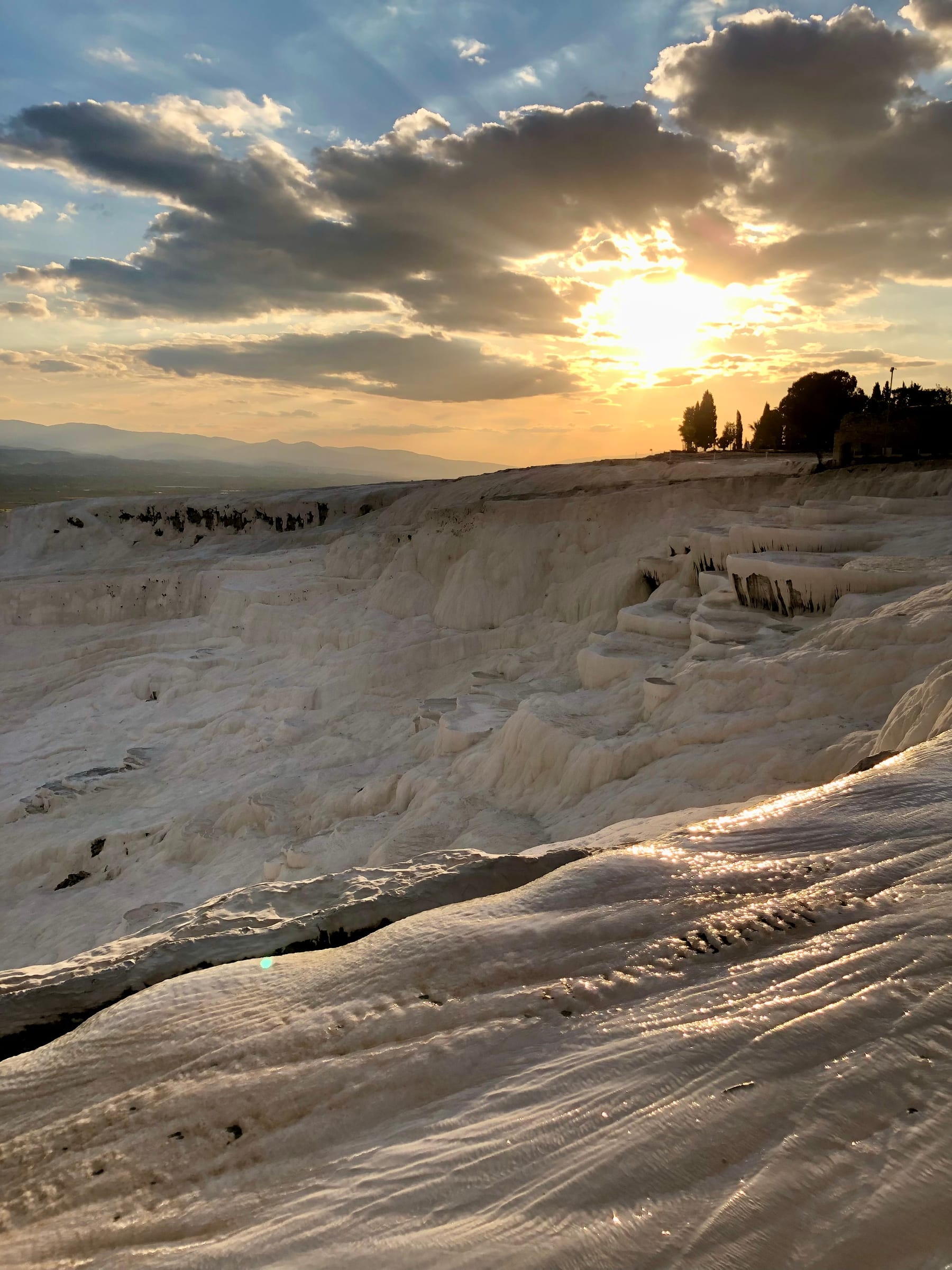
Pamukkale is a hillside of white travertine where mineral water has been spilling and hardening for thousands of years, terrace over terrace, until the whole slope looks like something that ought to be melting and never does. Photographs make it look like a curiosity. It is in fact an enormous Roman city — Hierapolis, spread across the plateau above — with a geological accident of great beauty on its edge.
Then a short flight north, and Istanbul again by the evening. This is the point of arranging the ten days this way: the last flight of your journey is behind you before your final morning begins.
Day ten — home
A transfer to the airport, and nothing else asked of you. Whatever hour your flight leaves, the morning is yours.
Shorter, or longer
Almost nobody travels these ten days exactly as written, and that is rather the point of writing them down. This is a starting shape. Here is how it moves.
To make it shorter, take out a whole place. Gallipoli, Pamukkale and Ephesus can each come out on their own, and the days close up neatly behind them, because none of the three is holding the others in place. Lose one and you have a nine-day trip; lose two and you have eight. What we would not do is keep all five places and squeeze them into fewer days — that is how a day at Ephesus becomes a drive with two short stops in it. The price follows the itinerary in both directions, and you see the whole of it before you decide anything.
To make it longer, add a day where you already are. A fourth day in Istanbul is the request we get most often, usually spent on a private Bosphorus cruise, with the palaces and the timber waterfront houses passing at the pace they were built to be seen.
The one thing we would gently resist is adding a sixth place. Let the journey breathe instead. Very few people come home wishing they had seen one more site. A great many wish they had been given one more morning where they already were.
Plan your ten days
The judgements above are ones we can only make because we run these days ourselves — which drive is worth making and which is a wasted morning, and why the second balloon morning is worth more than a hotel upgrade. Your guides are licensed and English-speaking, your vehicle is kept for your party alone, and your entrance fees are arranged before you arrive. Hotels are chosen to your budget, boutique through cave hotels to the genuinely grand, and each one is named in your quote before you commit to anything. There is no shopping stop written into any day of this itinerary, and there never will be: what you buy in Turkey, and whether you buy anything at all, is nobody’s business but yours.
Tell us your dates, how many of you are traveling, and which of these places you would most regret missing. We will come back with an itinerary built around your own flights, and one clear figure for the whole journey — arrived at once, with every question you have about what sits inside it answered plainly. You can see the shape of our longer journeys on our Turkey trips page.
Ten days is enough to see Turkey properly. It is only barely enough, which is exactly why the order matters.