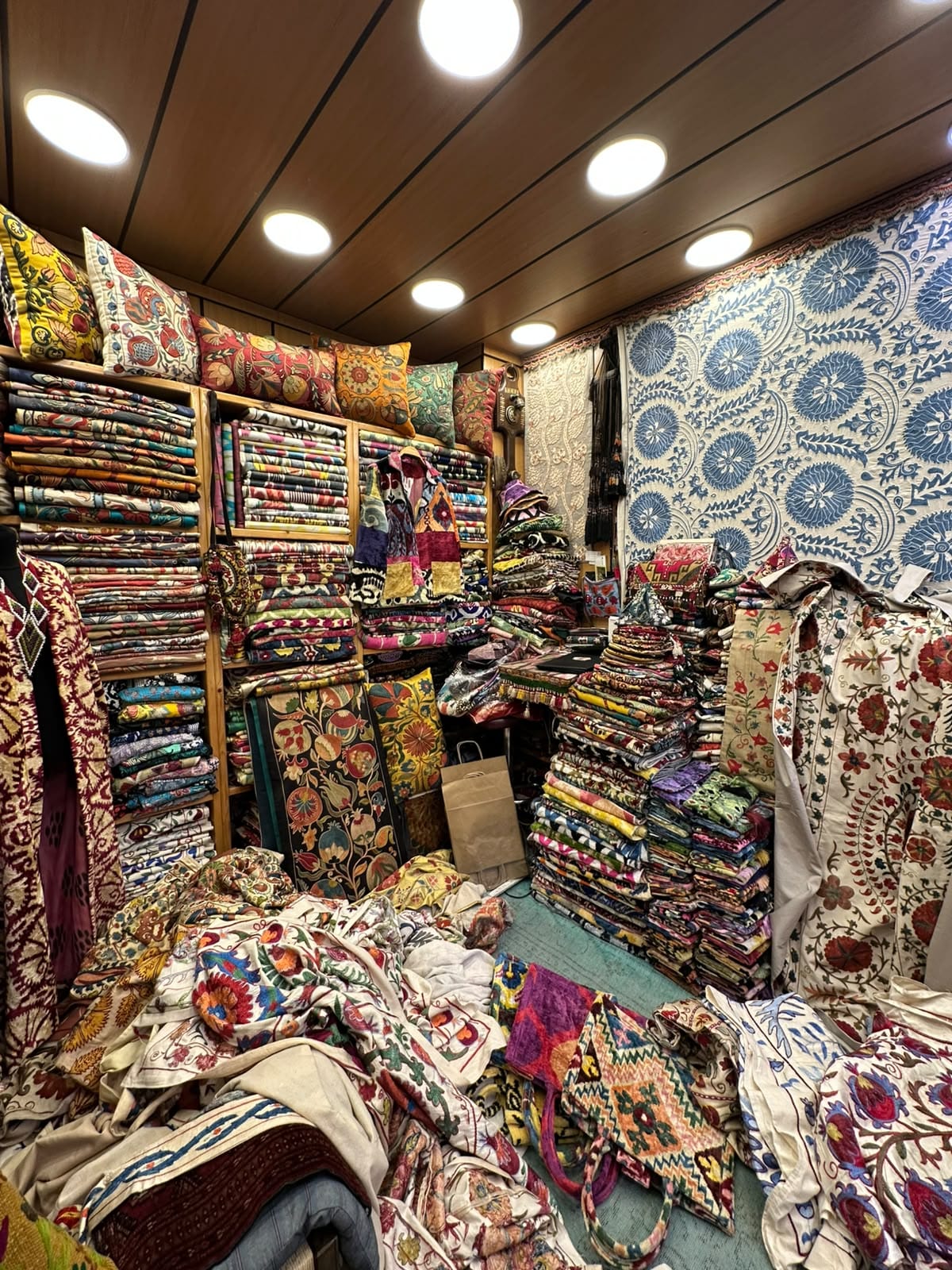
Istanbul still makes things the way it has always made them. A brass lantern is beaten out by hand. A box is inlaid with mother-of-pearl by a man who learned the craft from his father. A piece of jewelry is drawn on paper first, then cut and set at a workbench a few steps from where you are standing. A silk embroidery spent its first hundred years as a dowry in Samarkand. A single carpet can hold a quarter of a million knots, every one of them tied by hand.
None of that is a souvenir. These are pieces you live with, and they will outlast the trip by a generation.
We are a registered, owner-operated boutique travel agency in Istanbul, and most of what we do is private guided tours. Many of our American guests arrive with something particular in mind. A carpet for a room they have already measured. A ring or a pair of earrings made to order. Tiles for a kitchen back home. And underneath all of it is the same question: how do you buy something real in this city without being overcharged for it?
The answer has far less to do with haggling than people expect. Almost all of it comes down to who is standing next to you, and how that person gets paid.
We accept no commission from any vendor, on any tour, ever. Our guiding fee and our profit are agreed with you before you arrive. There is nothing more for us to earn from your day. That is why we can tell you a piece is beautiful, or tell you it is not worth the asking price, and you can believe us either way.
Who will be standing next to you?
This is the part that decides everything, so it is worth being specific about it.
Off The Beaten Path Istanbul is a licensed Turkish travel agency. We are a small team — four professional guides and two travel advisors — and we welcome more than four hundred guests a year, most of them from the United States, Canada and Australia. Our lead guide has twenty-two years behind him. The others each have more than fifteen.
That matters more in a carpet shop than it does in a museum. Fifteen years in this city means fifteen years of walking into these rooms, watching pieces come and go, learning which workshops are still weaving properly and which names are coasting on a reputation. Our guides know the dealers personally, and the dealers know they cannot try anything. They can tell hand-knotted from machine-made across a room, wool from silk by touch, and a genuine antique suzani from a clever recent one. They will translate for you, tell you the fair price before you are asked for one, and say so plainly when a piece is not worth it.
None of that is salesmanship, because there is nothing in it for them. It is simply what twenty years of doing this buys you — and on our tours it is standing next to you, included in the price.
What is actually worth buying in Istanbul?
The things Turkey has made well for centuries and still makes well today — and a few that pass through the city on their way somewhere else.
Carpets and rugs. Turkish rugs use the symmetrical knot, tied around two threads instead of one. It is slower to weave and it uses more wool, but it makes a denser pile that keeps its shape for generations. That is why antique Turkish rugs survive the way they do. It also means a claw has nothing to pull loose, so these are rugs for a house with dogs in it, not museum pieces to be roped off. Wool is the one you live on. Silk is something else entirely: a much finer knot, and far more of them to the inch. Walk around a silk rug and the color shifts as the light catches the pile from the other side. Hereke, Usak and Kayseri are the weaving names to know.
Iznik tiles and ceramics. Cobalt, turquoise and a deep red made from Armenian bole. These tiles have held their color on the walls of Istanbul’s mosques for four hundred years, which is a fair test of whether a glaze will survive your kitchen. Plates, bowls, framed panels, or a whole backsplash made to your measurements.
Jewelry. Rings, earrings, bracelets and necklaces, in gold or set with stones, and designers who will make a piece to your own drawing. Gold and stones trade on a world market, so the materials cost about the same everywhere. What changes from country to country is the work that goes into them. In Istanbul the craftsmanship is excellent and the making charge is low by American standards. That is the real reason to have a piece made here rather than buy one ready-made.
Leather. From tanneries that have supplied Europe for generations. The hide and the tanning are what separate a good jacket from an ordinary one, and there is a tailor to adjust the fit while you are still in the city.
What is a suzani, and why do collectors want one?
A suzani is a hand-embroidered textile from Central Asia — Uzbekistan and Tajikistan. The women of a family stitched them over years and gave them as part of a bride’s dowry: big flowering medallions and winding vines in silk thread, on cotton or silk. Every one is different, and no two were ever designed by committee.
They reach Istanbul the way they always have, along the trade routes that made this city. It is still one of the best places in the world to find a good antique one. Collectors frame them or hang them. They are art rather than soft furnishing, and they are the thing our guests most often did not know they were looking for.
Is it all inside the Grand Bazaar?
Some of it is, some of it is not — but all of it is in the same quarter.
The bazaar is the heart of this trade and always has been. Plenty of the people we work with have kept their rooms inside the covered streets for generations. Others are a few minutes away, in the working lanes that ring the bazaar, and they are there for practical reasons rather than any desire to leave. A jewelry designer needs a quiet studio to sit down with you and draw. A large carpet house needs floor space and daylight, because a serious rug has to be unrolled flat and seen properly, and the old covered lanes are too narrow for that.
So the day moves between the two, and it is all walkable. Some of it is the Bedesten and the workshops threaded around it. Some of it is a showroom around the corner with enough floor to lay out twenty carpets, or a workbench where a ring is being drawn to your description. Every tour we run is private, so the route follows what you came for rather than a fixed circuit.
How do you know the price is fair?
Two things, and neither of them is bargaining skill.
First, your guide tells you what a piece should cost before you sit down with the dealer. You are never working it out in the room, under pressure, with a glass of tea in your hand and three people watching you.
Second, we only introduce guests to firms we have known for years. They quote one honest price from the start. You will not be shown a high tag that turns into a generous discount the moment you hesitate. That is the oldest trick in the trade, and it is designed to make a visitor feel clever while costing them money.
What a guide is really for is reading the object itself: hand-knotted or machine-made, wool or silk, where it was woven and what that should mean for the price. That is not selling. It is the one thing you cannot do on your own.
Are there hidden fees on your tours?
No, and it matters more than it sounds, because a commission has to hide somewhere.
Your licensed guide and every entrance fee are inside the price we quote you, and so is our profit. You get a written list of exactly what is included, along with your itinerary, before you decide anything. We set out the whole calculation in what a private Istanbul tour really costs.
The one thing we leave out, deliberately, is lunch. A tour that includes lunch has already chosen the restaurant, and a restaurant chosen for a group is rarely the one you would have picked. It is the same arrangement as the back room of a shop, in a more comfortable chair. You eat where you like, and your guide will tell you honestly which places nearby are worth it.
Is there any pressure to buy?
None at all. But nobody selling to you is not the same as nobody helping you.
Plenty of our guests buy nothing at all. They spend the afternoon in the Bedesten, the old stone heart of the Grand Bazaar, where the antique dealers and the serious jewelers have kept their rooms for five hundred years. That is a complete afternoon, and nobody will be disappointed in you.
If buying is part of why you came, we are glad to help, and what we are good at is the handmade: rugs and carpets, Iznik tiles and ceramics, jewelry and worked gold, leather, suzani. These are the things where the gap between a good buy and a bad one is real money, and where an honest second opinion changes the outcome. On a keyring from the stall by the gate we are no use to you at all, and we will happily say so.
Can shopping be part of a sightseeing day?
Yes. Every tour we run is private and built to order, so shopping is never a fixed stop on a fixed route — it goes wherever you want it in the day, or nowhere at all. These are the tours it fits into:
The private shopping tour — the day built around buying. The Grand Bazaar and the working streets around it, taking in both the rooms inside the covered bazaar and the studios and carpet showrooms just beyond it, with someone who can tell the handmade from the merely handsome.
The Old City tour — Hagia Sophia, then Topkapi Palace or the Basilica Cistern, the Blue Mosque and the Hippodrome, with the Grand Bazaar as the last stop of the day. The easiest day to add an hour of looking to.
The two-day Istanbul tour — the complete city over two private days: the great icons first, then the local side. Our most booked itinerary, and the one with the most room in it.
Two Continents — cross from Europe to Asia and see the Istanbul that locals actually live in, markets included.
The tailor-made trip — tell us what you love and we design the days entirely around it. If you are furnishing a house, this is the one: we can arrange a furniture workshop where pieces are made to your own drawings, in the timber, upholstery and finish you choose, and shipped to the United States. Worth telling us before you travel.
A private guide on his own — if you already know Istanbul and want nothing but the expertise beside you, one flat fee for the day and you decide where it goes.
We also run a private Bosphorus day and an Istanbul food tour, which are not shopping days at all — but guests often pair one with a morning in the bazaar quarter, and we are glad to build it that way.
Planning it
If a carpet is on your list, two things help enormously and cost nothing. Bring the measurements of the room you want to fill, and a photo of it on your phone showing the floor, the light and the colors already in it. With those, a good dealer can narrow hundreds of rugs down to a handful.
Then write to us with your dates, how many of you there are, and what you are hoping to find. You will get back a proposed itinerary and a clear quote, put together by a travel advisor rather than a booking form. The guiding and every entrance fee are already inside the price, the few things that are not are listed plainly, and there is no commission of anybody’s anywhere in it.
And on the day, the person standing next to you in the shop will have been doing this for fifteen or twenty years, and will have nothing to gain from what you decide. That is the whole offer, and it is the reason guests tell us the bazaar felt completely different in our company.